
An MQTT device (MQTT connection) contains the connection settings for an MQTT broker or MQTT server. Multiple data points (topics) can be created per connection.
Clicking the ‘+ Add connection’ button creates a new entry in the list of MQTT connections.
No more than 20 MQTT connections can be added.
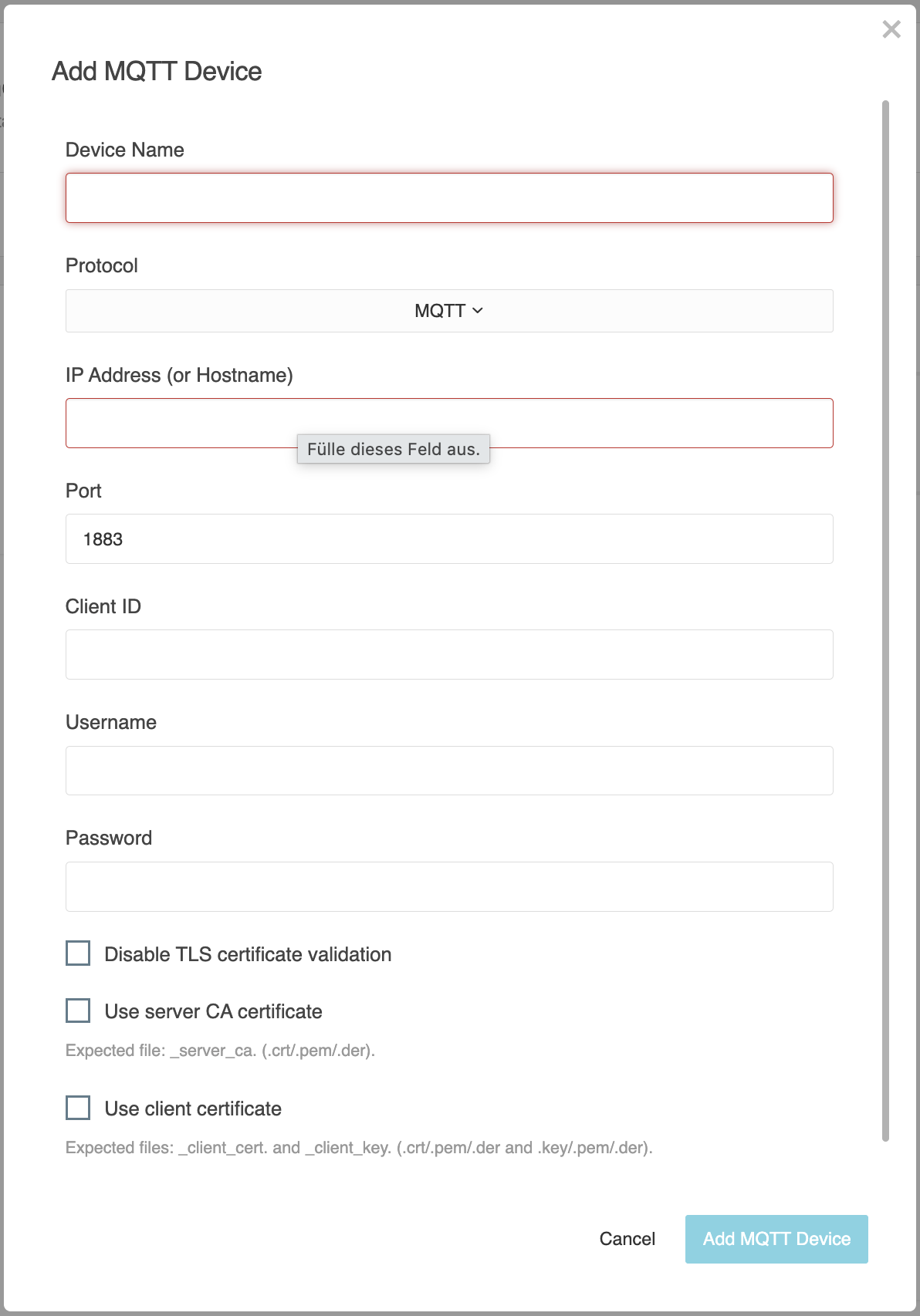
An MQTT device is only valid and can only be saved if the device name and host are entered correctly.
Device settings
The following fields are available for each MQTT device:
Device name
Enter a unique name for the MQTT device here to make it easier to identify in the overview.
This name is also used in the drop-down list for the logic editor elements “MQTT Value Input” and “MQTT Value Output”.
Protocol
The following protocols are available:
-
MQTT,
-
MQTTS,
-
WebSocket or
-
Secure WebSocket
IP Address (or Hostname)
Enter the IP address (broker address) or hostname of the MQTT device via which the connection is to be established.
Port
Enter the port of the Modbus TCP device via which the connection is established. The default value is 1883 for MQTT and 8883 for MQTTS.
Client ID
A unique identifier for the MQTT client to identify itself to the MQTT broker. Each active connection should use a unique Client ID.
Username
Username for authentication with the MQTT broker.
Password
Password for authenticating the user with the MQTT broker.
Usernames and passwords can also be used over unencrypted connections. In such cases, the login details are transmitted in plain text, which poses a security risk. The use of TLS-secured connections (MQTTS or Secure WebSocket) is recommended.
Option: Disable TLS certificate validation
Disables validation of the server certificate.
Disabling certificate validation poses a security risk, as the identity of the MQTT server is no longer verified. This means that tampered or untrusted servers may be accepted. Certificate validation should only be disabled for testing purposes or on trusted networks.
Option: Use server CA certificate
Uses a CA certificate to verify the trustworthiness of the MQTT broker.
Expected file: _server_ca (.crt/.pem/.der)
Option: Use client certificate
Enables authentication via a client certificate on the MQTT broker.
Expected files: _client_cert and _client_key (.crt/.pem/.der and .key/.pem/.der)
Certificates and TLS
Certificates can be used with MQTTS and Secure WebSocket.
For a server CA certificate, a file with the extension .crt, .pem or .der is required. For a client certificate, a client certificate file and a client key file are required. The key may have the extensions .key, .pem or .der.
Selected or previously uploaded certificates are displayed. If an expiry date is available, this is also shown. If certificate verification is disabled, the interface will highlight the security risk.
Administration
“+ Add device”
You can create a new MQTT connection by clicking on “+ Add connection”.
“Copy”
Clicking the copy icon copies the relevant MQTT connection. It is created as a new MQTT connection with the suffix “Copy of …” in its name.
When copying an existing MQTT connection, its data points are carried over. However, the broker address (e.g. hostname/IP) and any connection-related access details must be re-entered or checked for the new MQTT connection.
“Delete”
The selected MQTT device is removed using the bin icon.
Before deletion, the LOGIKEDITOR checks whether the MQTT connection is being used in any logic groups.
If it is being used in an active online logic group, it cannot be deleted. If it is only being used in a working copy, deletion is possible but will affect those logic groups.
During this process, all associated data points for this MQTT connection will also be deleted.
///