
MQTT data points describe the individual MQTT topics of an MQTT connection. They are used within logic groups via MQTT value inputs and MQTT value outputs.
A new data point is created by clicking on the grey area with the ‘plus’ sign.
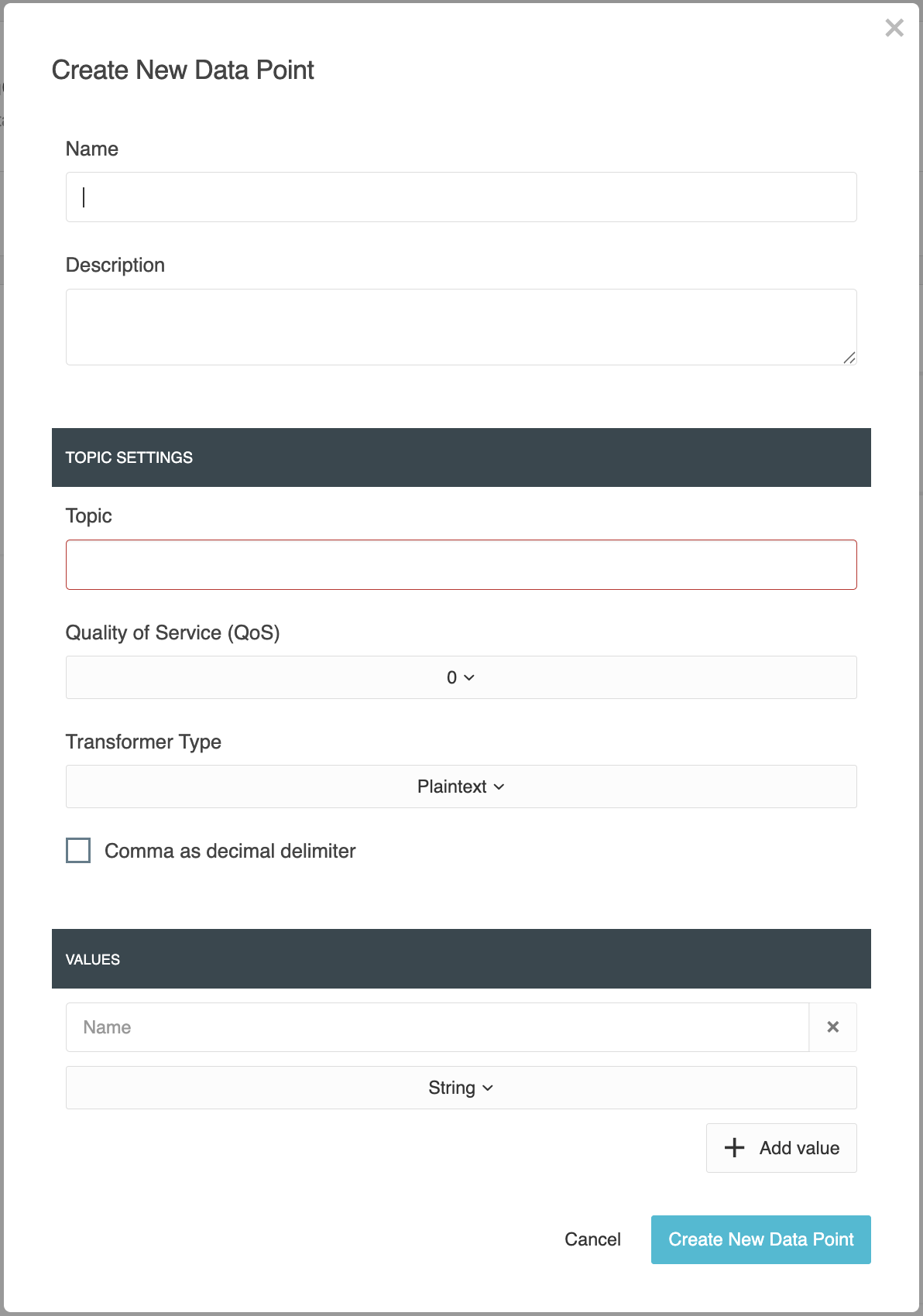
When creating a new data point, a window opens in which the parameters of the MQTT data point are defined. The topic is not assigned automatically, but must be entered by the user in accordance with the MQTT topic structure being used.
In addition, data points can be copied, selected individually or via multiple selection to delete several data points, and deleted together.
If an active logic group uses an MQTT data point, the interface displays a warning in the affected fields. Structure-relevant changes such as name, topic, QoS, transformer type, and values are locked.
Deletion is only possible once no active online logic group uses the data point anymore. If the data point is only used in a working copy, a warning is displayed before deletion.
General
-
Name:
Enter a descriptive name for the data point here. The name is used in the data point list and when selecting data points in logic groups. -
Description:
A more detailed description or important information about the data point can be entered in this text field.
Topic settings
This section is used to configure MQTT-specific parameters:
-
Topic
The MQTT topic via which the data point receives or sends data. The topic is required for the data point. -
Quality of Service (QoS)
Defines the delivery guarantee for MQTT messages.-
QoS 0 – At most once
The message is sent once. There is no acknowledgement from the broker. This level requires the least communication overhead but does not guarantee delivery. -
QoS 1 – At least once
The message is resent until the broker acknowledges receipt. This ensures delivery, but messages may be received multiple times. -
QoS 2 – Exactly once
The message is transmitted using an enhanced acknowledgement mechanism. This ensures that the message is delivered exactly once. This level offers the highest reliability but incurs the greatest communication overhead.
-
-
Transformer type
The transformer type determines how the received or outgoing MQTT message is interpreted. The following options are available:-
Plaintext
The MQTT payload is processed as a plain text value. The entire message content corresponds to the value of the data point. -
JSON
The MQTT payload is processed as a JSON structure. This allows specific values within a JSON object to be read or written.
-
-
Comma as decimal separator
Enables the use of a comma instead of a full stop as the decimal separator when processing numerical values.
Values
An MQTT data point contains at least one value and a maximum of 20 values. A value is added via the grey area with the ‘plus’ sign.
Within an MQTT data point, value names must be unique and cannot be empty. The values subsequently determine the inputs or outputs of the logic element. An MQTT data point with multiple values creates a corresponding number of ports in the logic group.
The following are available for each value:
-
Name
Unique identifier for the MQTT data point. The name is used to identify and utilise the data point within the project and the logic. -
Data type
The data type determines how the value of an MQTT data point is interpreted and processed.The following data types are available:
-
Boolean
Processes the value as a Boolean value (true or false). Suitable for switch states or binary information. -
Float
Processes the value as a floating-point number with decimal places. Suitable for measured values such as temperatures, voltages or other continuous values. -
Integer
Processes the value as an integer without decimal places. Suitable for meter readings, status codes or other numerical values. -
String
Processes the value as a string. Suitable for text, labels or any alphanumeric content.
-
///