
Content
Information
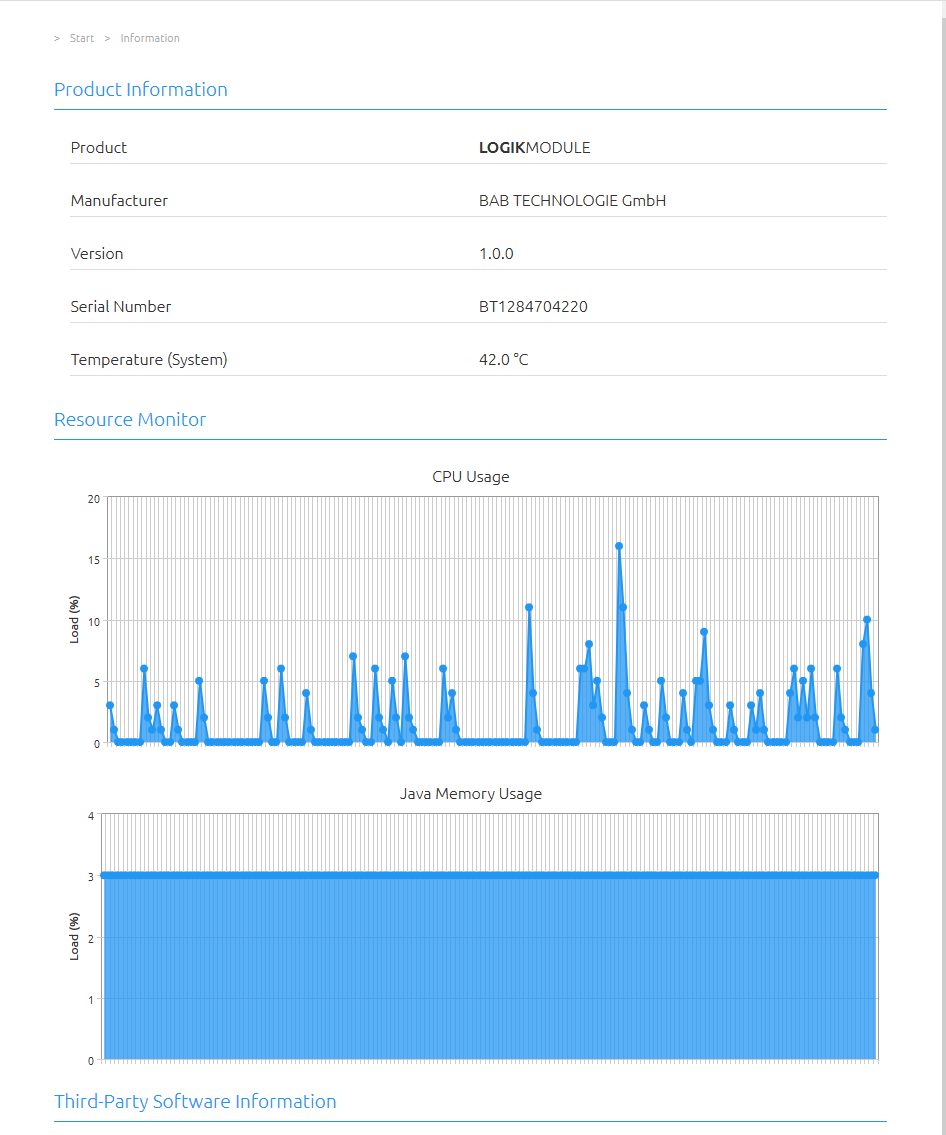
The Information view displays key system and device information for the LOGIKMODULE.
It can be used to check the current device status and view important information such as the product name, manufacturer, firmware version, serial number, and system temperature.
In addition, information about the current system load as well as the software components and licenses used is available.
Device Information
The upper section displays basic information about the LOGIKMODULE:
-
Product
Name of the device. -
Manufacturer
Manufacturer of the device. -
Version
Currently installed firmware version. -
Serial Number
Unique serial number of the device. -
Temperature (System)
Current internal system temperature of the LOGIKMODULE.
System Monitor
The System Monitor section displays the current device load in graphical form.
This includes, among other things:
-
Processor Load
Displays the current CPU load of the system. -
Java Memory Usage
Displays the current memory usage of the Java runtime environment.
The diagrams make it easier to assess the current system load and can be useful when analyzing performance or stability issues.
Software Licenses
The Software Licenses section provides information about the software components used in the LOGIKMODULE and their license terms.
Note
The values displayed in the Information view are intended primarily for system monitoring and diagnostics. Changes to the device configuration are made in the corresponding sections under Configuration.
Attachment
KNX Data Points
KNX data points describe the data used within a KNX installation and its format.
The assignment is based on standardized KNX Data Point Types (DPT). These define, among other things, the data length, the interpretation of the value, and the permitted value range.
The following overview shows common EIS types and the corresponding KNX Data Point Types.
|
EIS Type |
Description |
Resolution |
Data Type |
Value Range |
|---|---|---|---|---|
|
EIS 1 |
Switching |
1 bit |
DPT 1.001 |
[0 ... 1] |
|
EIS 2 |
Switching |
1 bit |
DPT 1.001 |
[0 ... 1] |
|
EIS 2 |
Relative dimming |
4 bit |
DPT 3.007 |
[Brighter ... Darker ... Stop] |
|
EIS 2 |
Absolute dimming value |
1 byte |
DPT 5.001 |
[0% ... 100%] (step size 0.4%) |
|
EIS 3 |
Time |
3 byte |
DPT 10.001 |
|
|
EIS 4 |
Date |
3 byte |
DPT 11.001 |
|
|
EIS 5 |
Floating-point number |
2 byte |
DPT 9.xxx |
[-671088.64 ... 670760.96] |
|
EIS 6 |
Scaling |
1 byte |
DPT 5.xxx |
[0x ... 255x] (step size x) |
|
EIS 6 |
Percentage |
1 byte |
DPT 5.001 |
[0% ... 100%] (step size 0.4%) |
|
EIS 6 |
Angle |
1 byte |
DPT 5.003 |
[0° ... 360°] (step size 1.41°) |
|
EIS 7 |
Drive control movement (direction) |
1 bit |
DTP 1.008 |
[Up (0) ... Down (1)] |
|
EIS 7 |
Drive control step (direction) / Stop |
1 bit |
DTP 1.007 |
[Up (0) ... Down (1)] |
|
EIS 9 |
Floating-point number (high precision) |
4 byte |
DPT 14.xxx |
[-3.4028*10^38 ... 3.4028*10^38] |
|
EIS 10 |
Unsigned integer |
2 byte |
DPT 7.001 |
[0 ... 65535] |
|
EIS 10 |
Signed integer |
2 byte |
DPT 8.001 |
[-32768 ... 32767] |
|
EIS 11 |
Unsigned integer (large value range) |
4 byte |
DPT 12.001 |
[0 ... 4294967296] |
|
EIS 11 |
Signed integer (large value range) |
4 byte |
DPT 13.001 |
[-2147483648 ... 2147483647] |
|
EIS 14 |
Unsigned integer (small value range) |
1 byte |
DPT 5.010 |
[0 ... 255] |
|
EIS 14 |
Signed integer (small value range) |
1 byte |
DPT 6.001 |
[-128 ... 127] |
|
EIS 15 |
Character string (14 ASCII characters) |
14 byte |
DPT 16.000 |
Character |
EIB/KNX devices exchange fixed prescribed data formats with each other. These are defined in types.
The old designations of the types are EIS (EIB Interworking Standard)
The new designations are DPT (Data Point Type)
///