
The configuration of logic elements, as well as linking the logic elements to inputs and outputs is performed within so-called logic groups. Therefore, the logic group configuration represents the canvas.

There are the following functions for working within the logic group configuration:
Create a new Logic Group
To create a logic group, please click on "+ New Group" in the expanded Logic groups menu (left-hand side).

Add Value Inputs / Value Outputs

If you only want to add one element of one type, you may simply double-click on the symbol. Otherwise, enter the desired amount in each input. You can cycle quickly through inputs using the tab key. You can type in a number, or you can alter the default zero using the arrows next to the input. Finally, if you click into an input field you can also increase or decrease the amount using your mouse wheel or the arrow keys of your keyboard. The fastest way is cycling through all fields using the tab key and the selecting the amount using the arrow keys.

As soon as at least one element has a quantity larger than 0, the button "Add Selection" will be enabled. Additional information on the configuration of data points and inputs & outputs can be found in chapter Datapoints.
Add Logic Elements


If you only want to add a single item of a specific type, simply double-click on the corresponding icon.
To add multiple items, enter the desired quantity into the appropriate input fields. You can quickly switch between fields using the Tab key.
There are several ways to change the value in an input field:
-
Enter the number manually,
-
use the arrows next to the input field,
-
or scroll with the mouse wheel or use the arrow keys on your keyboard once the field is active.
The fastest way is to navigate through all fields using the Tab key and adjust the values with the arrow keys.
As soon as at least one item has a quantity greater than 0, the “Add Selection” button becomes active.
The individual logic element types are described in more detail in chapter Logik elements.
Add Tools

Click the desired tool and drag it to your logic group. You may also drag a tool directly to a connection. The individual tools are described in more detail in chapter Tools.
Creating Connections Between Logic Elements and Tools
Logic elements and tools are connected to each other within a logic group via their inputs and outputs.
To create a connection, click the required input or output of a logic element or tool and hold down the mouse button.
Then drag the connection, while keeping the mouse button pressed, to the corresponding output or input of the other element.
Once the appropriate connection point is reached, release the mouse button. The connection is created automatically and displayed as a connection line between the two elements.

Note
A connection can be drawn either from an output to an input or from an input to an output.
Whether a connection is possible depends, among other things, on the supported data types of the involved connection points.
Simulate a Logic Group

Simulation includes the following functions
-
Defined start date
-
Start/stop
-
Time lapse
To send values to your logic group during the simulation, simply double-click on the value inputs in the logic group.
Please note that in order to save resources, some logic elements (e.g. timer, week clock, ...) only work when outputs are linked to others. Details can be found in the individual descriptions.
The logic elements Alexa Device, Alexa Scene, http-Request and LUA Script can currently not be simulated.
Activating a Logic Group
A logic group is executed on the device only after it has been activated. Until then, the logic group exists only in the working copy.
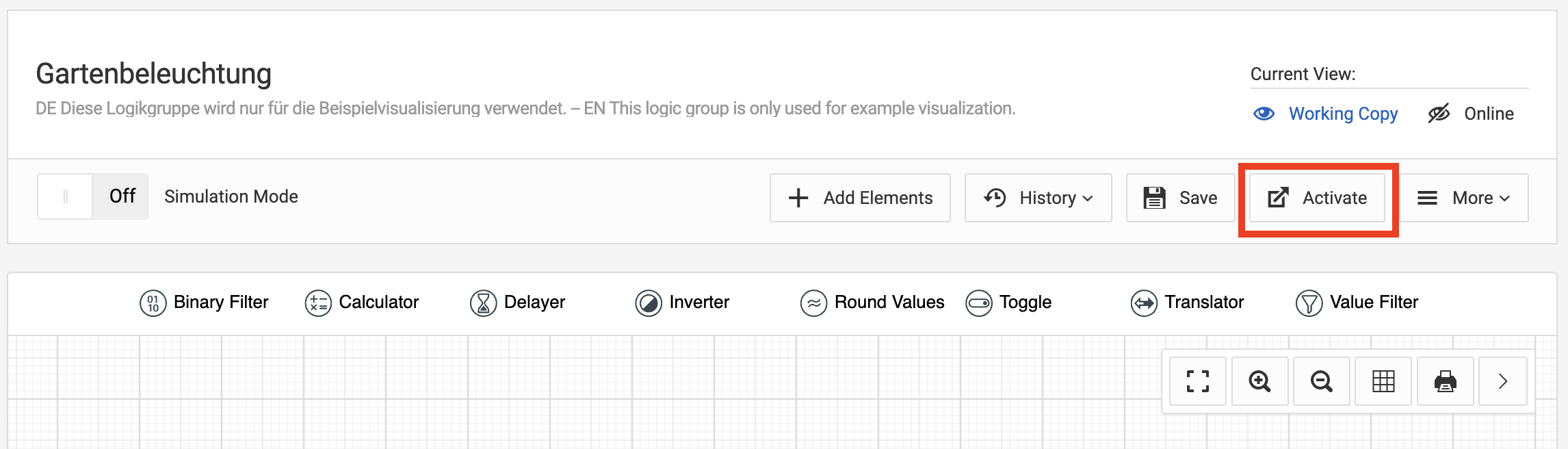
After activation, the logic group processes the configured data points and communicates with the assigned systems and interfaces, for example KNX.
For an active logic group, the Online button is available.
In Online Mode, the version of the logic group currently running on the device is displayed. This version may differ from the working copy if changes have already been made there but have not yet been activated.
In addition, the current state of the logic group can be queried in Online Mode.
The current values and states are displayed directly at the corresponding logic elements, similar to Simulation Mode.
Note
Changes made in the working copy affect the running logic group only after the modified version has been activated again.
Deactivating a Logic Group
Enable objects can be used to control the operation of a logic group selectively. In addition, a logic group can be completely deactivated.
To do this, open the required logic group in Online Mode.
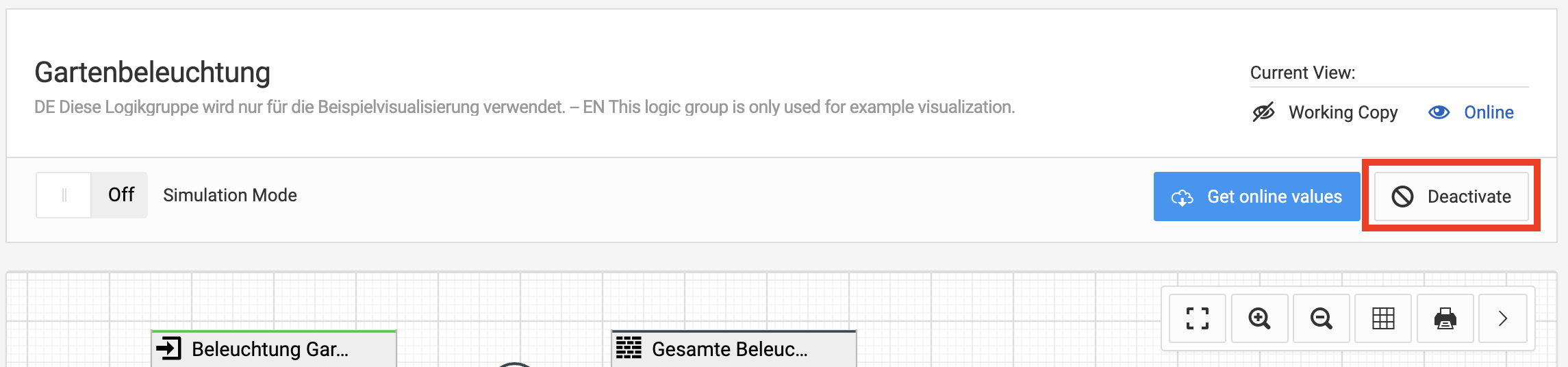
If the logic group is active, the Deactivate button is displayed. Click Deactivate to stop execution of the logic group completely.
After deactivation, the status of the logic group is updated accordingly and displayed in the user interface.
Note
A deactivated logic group is not executed. It can be activated again at any time.
Import / Export
With the help of the Import / Export function, individual logic groups can be saved and restored. This way, logic groups can be reused in other devices as well.

///